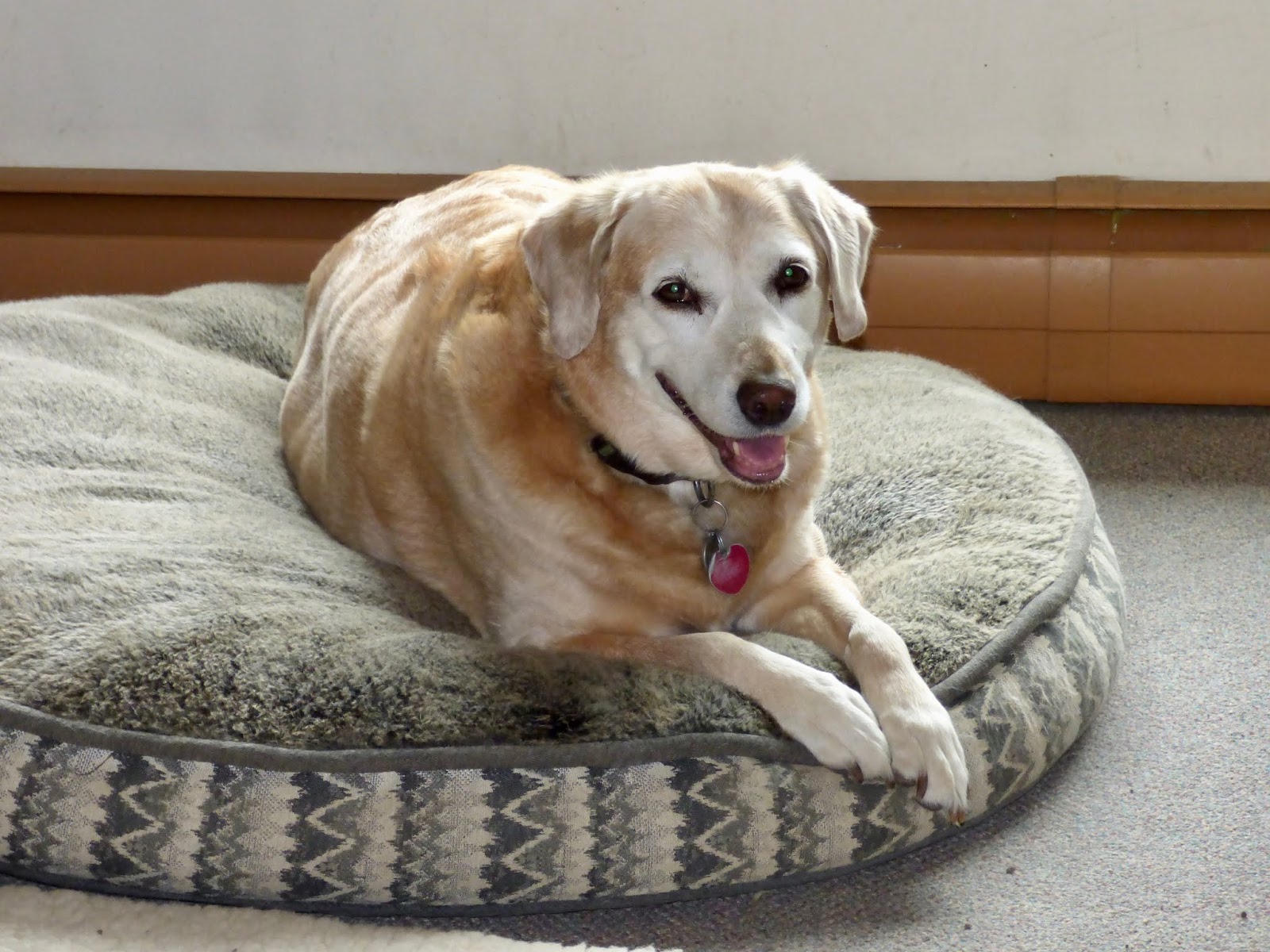
| Domestic dog Temporal range: Late Pleistocene – Present (14,700–0 years BP) | |
|---|---|
 | |
| Selection of the different breeds of dog | |

The domestic dog (Canis lupus familiaris when considered a subspecies of the gray wolf or Canis familiaris when considered a distinct species)[4] is a member of the genus Canis (canines), which forms part of the wolf-like canids,[5] and is the most widely abundant terrestrial carnivore.[6][7][8][9][10] The dog and the extant gray wolfare sister taxa[11][12][13] as modern wolves are not closely related to the wolves that were first domesticated,[12][13] which implies that the direct ancestor of the dog is extinct.[14] The dog was the first species to be domesticated[13][15] and has been selectively bred over millennia for various behaviors, sensory capabilities, and physical attributes.[16]
Their long association with humans has led dogs to be uniquely attuned to human behavior[17] and they are able to thrive on a starch-rich diet that would be inadequate for other canid species.[18] New research seems to show that dogs have mutations to equivalent genetic regions in humans where changes are known to trigger high sociability and somewhat reduced intelligence.[19][20] Dogs vary widely in shape, size and colors.[21] Dogs perform many roles for people, such as hunting, herding, pulling loads, protection, assisting police and military, companionship and, more recently, aiding handicapped individuals and therapeutic roles. This influence on human society has given them the sobriquet "man's best friend".
Etymology
The term "domestic dog" is generally used for both domesticated and feral varieties. The English word dog comes from Middle English dogge, from Old English docga, a "powerful dog breed".[22] The term may derive from Proto-Germanic *dukkōn, represented in Old English finger-docce ("finger-muscle")[23] or (as suggested by Piotr Gąsiorowski) the Old English colour adjective dox, meaning "brown" or "tan".[24] In either case, the word seems to have been derived via the diminutive suffix -ga also seen in frogga "frog", picga "pig", stagga "stag", wicga "beetle, worm", among others.[25]
In 14th-century England, hound (from Old English: hund) was the general word for all domestic canines, and dog referred to a subtype of hound, a group including the mastiff. It is believed this "dog" type was so common, it eventually became the prototype of the category "hound".[26] By the 16th century, dog had become the general word, and hound had begun to refer only to types used for hunting.[27] The word "hound" is ultimately derived from the Proto-Indo-European word *kwon-, "dog".[28] This semantic shift may be compared with in German, where the corresponding word Hund kept its original meaning. (German, like other European languages, has a word borrowed from the English dog which refers specifically to mastiffs.[29]) The term *ḱwon- may ultimately derive from the earliest layer of Proto-Indo-European vocabulary.[30]
A male canine is referred to as a "dog", while a female is traditionally called a "bitch" (derived from Middle English bicche, from Old English bicce, ultimately from Old Norse bikkja). Since the word "bitch" has taken on derogatory connotations, nowadays it is less commonly used to refer to dogs.[citation needed] The father of a litter is called the sire, and the mother is called the dam. The process of birth is "whelping", from the Old English word hwelp; the modern English word "whelp" is an alternative term for puppy.[31] A litter refers to the multiple offspring at one birth which are called puppies or pups from the French poupée, "doll", which has mostly replaced the older term "whelp".[32]
...
Origin

The origin of the domestic dog is not clear. It is known that the dog was the first domesticated species.[13][15] The domestic dog is a member of the genus Canis (canines), which forms part of the wolf-like canids,[5] and is the most widely abundant terrestrial carnivore.[6][7][8][9][10] The closest living relative of the dog is the gray wolf and there is no evidence of any other canine contributing to its genetic lineage.[7][8][47][11] The dog and the extant gray wolf form two sister clades,[11][12][13] with modern wolves not closely related to the wolves that were first domesticated.[12][13] The archaeological record shows the first undisputed dog remains buried beside humans 14,700 years ago,[48] with disputed remains occurring 36,000 years ago.[49] These dates imply that the earliest dogs arose in the time of human hunter-gatherers and not agriculturists.[8][12]
Where the genetic divergence of dog and wolf took place remains controversial, with the most plausible proposals spanning Western Europe,[50][8] Central Asia,[50][51] and East Asia.[50][52] This has been made more complicated by the most recent proposal that fits the available evidence, which is that an initial wolf population split into East and West Eurasian wolves, these were then domesticated independently before going extinct into two distinct dog populations between 14,000-6,400 years ago, and then the Western Eurasian dog population was partially and gradually replaced by East Asian dogs that were brought by humans at least 6,400 years ago.[50][53][54]
...
Differences from wolves

Despite their close genetic relationship and the ability to inter-breed, there are a number of diagnostic features to distinguish the gray wolves from domestic dogs. Domesticated dogs are clearly distinguishable from wolves by starch gel electrophoresis of red blood cell acid phosphatase.[65] The tympanic bullae are large, convex and almost spherical in gray wolves, while the bullae of dogs are smaller, compressed and slightly crumpled.[66]Compared with equally sized wolves, dogs tend to have 20% smaller skulls and 30% smaller brains.[67]:35 The teeth of gray wolves are also proportionately larger than those of dogs.[68] Dogs have a more domed forehead and a distinctive "stop" between forehead and nose.[69] The temporalis muscle that closes the jaws is more robust in wolves.[4]:p158Wolves do not have dewclaws on their back legs, unless there has been admixture with dogs that had them.[70] Most dogs lack a functioning pre-caudal gland and enter estrustwice yearly, unlike gray wolves which only do so once a year.[71] So-called primitive dogs such as Dingoes and Basenjis retain the yearly estrus cycle.[72] Dogs generally have brown eyes and wolves almost always have amber or light colored eyes.[73] The skin of domestic dogs tends to be thicker than that of wolves, with some Inuit tribes favoring the former for use as clothing due to its greater resistance to wear and tear in harsh weather.[74] The paws of a dog are half the size of those of a wolf, and their tails tend to curl upwards, another trait not found in wolves[75] The dog has developed into hundreds of varied breeds, and shows more behavioral and morphological variation than any other land mammal.[76] For example, height measured to the withers ranges from a 6 inches (150 mm) in the Chihuahua to 3.3 feet (1.0 m) in the Irish Wolfhound; color varies from white through grays (usually called "blue") to black, and browns from light (tan) to dark ("red" or "chocolate") in a wide variation of patterns; coats can be short or long, coarse-haired to wool-like, straight, curly, or smooth.[77] It is common for most breeds to shed their coat.
...
Intelligence
Dog intelligence is the ability of the dog to perceive information and retain it as knowledge for applying to solve problems. Dogs have been shown to learn by inference. A study with Rico showed that he knew the labels of over 200 different items. He inferred the names of novel items by exclusion learning and correctly retrieved those novel items immediately and also 4 weeks after the initial exposure. Dogs have advanced memory skills. A study documented the learning and memory capabilities of a border collie, "Chaser", who had learned the names and could associate by verbal command over 1,000 words. Dogs are able to read and react appropriately to human body language such as gesturing and pointing, and to understand human voice commands. Dogs demonstrate a theory of mind by engaging in deception. An experimental study showed compelling evidence that Australian dingos can outperform domestic dogs in non-social problem-solving, indicating that domestic dogs may have lost much of their original problem-solving abilities once they joined humans.[111] Another study indicated that after undergoing training to solve a simple manipulation task, dogs that are faced with an insoluble version of the same problem look at the human, while socialized wolves do not.[112] Modern domestic dogs use humans to solve their problems for them.[113][114]
...